Stanley Defiance Chisels and Chisel Sets
Defiance Chisels & Chisel Sets
The Defiance chisel line is considerably deeper than it first appears. Stanley offered traditional hickory-handled socket chisels, amber composition-handle tang chisels, thin paring chisels, pocket chisels and several boxed assortments. Add in reused model numbers, later packaging variations and a few poorly documented survivors, and what looks like a small collecting category quickly becomes another proper rabbit hole.
The 1939 Catalog Gives Us a Rarely Clear Snapshot
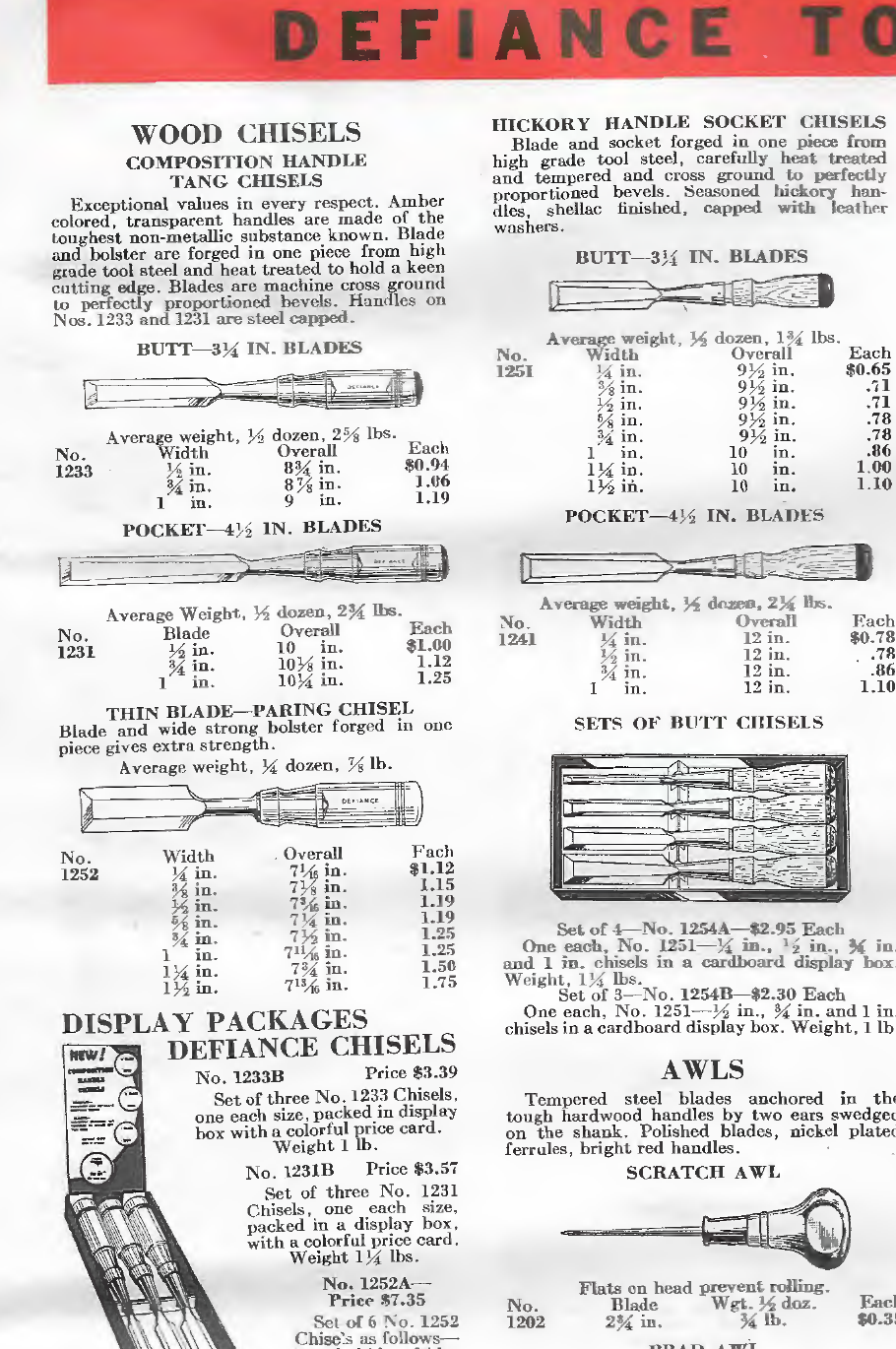
One of the strongest sources for this part of the Defiance project is Stanley Tools Catalog No. 139 from 1939. Page 252 places several Defiance chisel families together on one page and gives us model numbers, sizes, construction details, packaged sets and period prices.
The catalog separates the chisels into two broad groups. Nos. 1231, 1233 and 1252 use composition handles and tang construction, while Nos. 1241 and 1251 use traditional hickory handles and socket construction. That makes the 1939 page particularly useful when identifying loose chisels whose original packaging is long gone.
The Main Defiance Chisel Families
These are the principal chisel families documented together in the 1939 Defiance catalog. Their construction varies enough that a mixed group of Defiance chisels can look as though it came from several completely different product lines.
Composition-Handle Butt Chisels
Shorter butt-style tang chisels fitted with transparent amber composition handles. Stanley described the blade and bolster as being forged in one piece from high-grade tool steel and heat treated to hold a cutting edge.
The handles were steel capped, giving these chisels a distinctive appearance that makes intact examples fairly easy to recognize.
Composition-Handle Pocket Chisels
The longer companion to the 1233 family. These use the same basic amber composition-handle approach but have longer pocket-style blades and greater overall length.
Like the 1233, the 1231 handles were steel capped and were sold both individually and in a boxed assortment.
Thin-Blade Paring Chisels
A much broader size range was available in the No. 1252 family. These composition-handled chisels use a thin blade intended for paring work, with the blade and wide bolster forged as one piece.
The complete run is particularly interesting because the 1939 catalog lists eight different widths, making a full size set considerably harder to assemble than the more compact 1231 or 1233 families.
Hickory-Handle Socket Butt Chisels
One of the best documented Defiance edge-tool families. The blade and socket were forged as one piece from tool steel, while the handles were seasoned hickory with a shellac finish and leather washers at the socket.
The No. 1251 was offered in eight widths and also formed the basis of the boxed 1254A and 1254B assortments.
Hickory-Handle Pocket Socket Chisels
The longer socket-chisel counterpart to the 1251 family. The 1939 catalog lists each version at approximately twelve inches overall, giving the 1241 a noticeably different profile from the shorter butt chisels.
One Brand, Several Jobs
Butt chisels, pocket chisels and paring chisels were not simply cosmetic variations. Their proportions made them better suited to different jobs, and Stanley was clearly trying to give the lower-priced Defiance line a useful selection rather than selling one generic chisel in a handful of widths.
That diversity is one reason this category deserves more than a simple list of model numbers.
Working Defiance Chisel Registry
This combines the models directly documented in the 1939 catalog with additional tools and variants identified during the broader Defiance research project. “Research” does not mean the tool is imaginary; it means some part of its date, packaging, configuration or relationship to other models still needs to be reconciled.
| Model | Type | Sizes / Contents | Research Notes | Evidence |
|---|---|---|---|---|
| 1231 | Composition Pocket | 1/2″, 3/4″, 1″ | Amber composition handle; steel capped. | 1939 Catalog |
| 1231B | Display Set | Three No. 1231 chisels, one of each catalog size | Boxed with a colorful retail price card. | 1939 Catalog |
| 1233 | Composition Butt | 1/2″, 3/4″, 1″ | Amber composition handle; steel capped. | 1939 Catalog |
| 1233B | Display Set | Three No. 1233 chisels, one of each catalog size | 1939 catalog shows a display box, not a four-chisel pouch. | 1939 Catalog |
| 1241 | Socket Pocket | 1/4″, 1/2″, 3/4″, 1″ | Hickory handles; approximately 12″ overall. | 1939 Catalog |
| 1251 | Socket Butt | 1/4″, 3/8″, 1/2″, 5/8″, 3/4″, 1″, 1-1/4″, 1-1/2″ | Hickory handle, shellac finish and leather washer. | 1939 Catalog |
| 1252 | Thin Paring | 1/4″, 3/8″, 1/2″, 5/8″, 3/4″, 1″, 1-1/4″, 1-1/2″ | Composition handle; thin blade and wide forged bolster. | 1939 Catalog |
| 1252A | Display Set | Six No. 1252 chisels: two each 1/2″, 3/4″ and 1″ | Retail display assortment rather than one complete size run. | 1939 Catalog |
| 1254A | Socket Chisel Set | Four No. 1251 chisels: 1/4″, 1/2″, 3/4″, 1″ | Cardboard display box. | 1939 Catalog |
| 1254B | Socket Chisel Set | Three No. 1251 chisels: 1/2″, 3/4″, 1″ | Smaller cardboard display-box assortment. | 1939 Catalog |
| 1221 | Long Socket | Multiple surviving widths documented | Physical examples exist, but the number conflicts with the 1939 No. 1221 square. | Research |
| 1233R | Chisel Set | Configuration still being reconciled | Appears in current research as another packaged 1233 assortment. | Research |
| Artisan No. 1 | Gift Set | Associated with the 1252 family | Distinctive gift-oriented packaging; surviving details remain under study. | Research |
| 10 7/8 | Cold Chisel | 1″ | Metalworking rather than woodworking edge tool. | Research |
A Particularly Useful Reference Model
The No. 1251 is one of the better anchors for identifying Defiance chisels because Stanley documented the construction clearly and offered the model across a broad range of widths. The blade and socket were forged together from tool steel, while the hickory handle was shellac finished and protected at the socket by a leather washer.
The family ran from 1/4 inch through 1-1/2 inches, and the model also appeared in boxed assortments. A 1/2-inch No. 1251 is even documented among the tools supplied with the Defiance No. 890 homeowner’s tool chest, connecting the individual chisel line directly to Stanley’s complete Defiance tool sets.
The Boxed Sets — Where Things Get Interesting
Individual chisels survived because they were useful. Packaging generally survived because somebody forgot to throw it away, which makes intact boxed assortments particularly valuable for research. The prices below are the original 1939 catalog prices, not modern collector values.
Three composition-handle No. 1233 butt chisels, one each in 1/2″, 3/4″ and 1″, packed in a display box.
Three No. 1231 pocket chisels, one of each cataloged size, supplied in a retail display box.
Six No. 1252 paring chisels: two each in 1/2″, 3/4″ and 1″, packaged as a retail display assortment.
Four No. 1251 socket butt chisels: 1/4″, 1/2″, 3/4″ and 1″, supplied in a cardboard display box.
Three No. 1251 socket butt chisels: 1/2″, 3/4″ and 1″, in the smaller cardboard display-box assortment.
And Then There Are the Ones That Complicate Everything
As usual with Defiance, finding an original catalog solves several questions and immediately creates several more.
The No. 1221 Chisel Problem
Surviving chisels stamped DEFIANCE by STANLEY No. 1221 are documented, including multiple physical examples. The problem is that the 1939 Defiance catalog assigns No. 1221 to a try-and-mitre square. Whether the chisel belongs to an earlier period, a later reuse of the number, or another catalog sequence remains an excellent research question.
The 1233B / 1233R Packaging Question
The 1939 catalog is unambiguous about the 1233B: three No. 1233 chisels in a display box. Later research also records a 1233R assortment, and earlier collector notes associated some examples with pouches. Those later packaging variations should be documented separately instead of being blended into the known 1939 configuration.
The Artisan Gift Set
Current research records an Artisan No. 1 gift set associated with the 1252 family. Gift packaging is particularly useful because it can reveal how Stanley reused existing tools for seasonal and retail-oriented assortments that may not appear in the ordinary individual-tool listings.
The No. 10 7/8 Cold Chisel
Not every Defiance chisel was intended for woodworking. The documented No. 10 7/8 cold chisel broadens the category into general metalworking and serves as another reminder that the Defiance name covered a much larger workshop ecosystem than planes and woodworking tools alone.
What to Look for When Identifying One
Handles are replaced, blades are shortened by decades of sharpening, boxed sets get split up and model numbers get reused. Identification is therefore strongest when several features agree rather than when one detail is used by itself.
Surviving examples may carry DEFIANCE, DEFIANCE by STANLEY, a model number and MADE IN U.S.A. markings. Never assume an unmarked replacement handle or missing label rules a genuine tool out.
The 1939 catalog gives us a useful dividing line. Nos. 1241 and 1251 are socket chisels with hickory handles, while 1231, 1233 and 1252 are composition-handle tang chisels.
The amber transparent composition handles on the 1231, 1233 and 1252 families are distinctive. Nos. 1231 and 1233 were specifically described as having steel-capped handles.
Original boxes, cards, sleeves and pouches can answer questions the tool itself cannot. Photograph the packaging before separating anything, especially model numbers, printed prices and contents lists.
Width can help place a chisel within a documented family and can expose an incorrectly assembled set. The 1939 catalog provides several complete size runs for comparison.
The 1221 situation is not unique within Defiance. Stanley reused numbers across different tool categories and periods, so the number should identify a candidate—not end the investigation.
Continue Through the Defiance Archive
The chisels are only one branch of a tool line that eventually covered most of the ordinary workshop.