Stanley Defiance Clamp on Vises and Wedges
Defiance Clamp-On Vises & Wedge Vise
Defiance vises are a small category compared with the hand planes, but they are a surprisingly interesting one. Stanley offered compact clamp-on bench vises in several sizes, including an indexed swivel model, and later added the unusual No. 1240 wedge vise. Between original catalogs, patent records, surviving examples and a few very scarce boxed tools, these simple holding devices reveal considerably more engineering than their budget-tool reputation might suggest.
Three Defiance Bench Vises in 1939
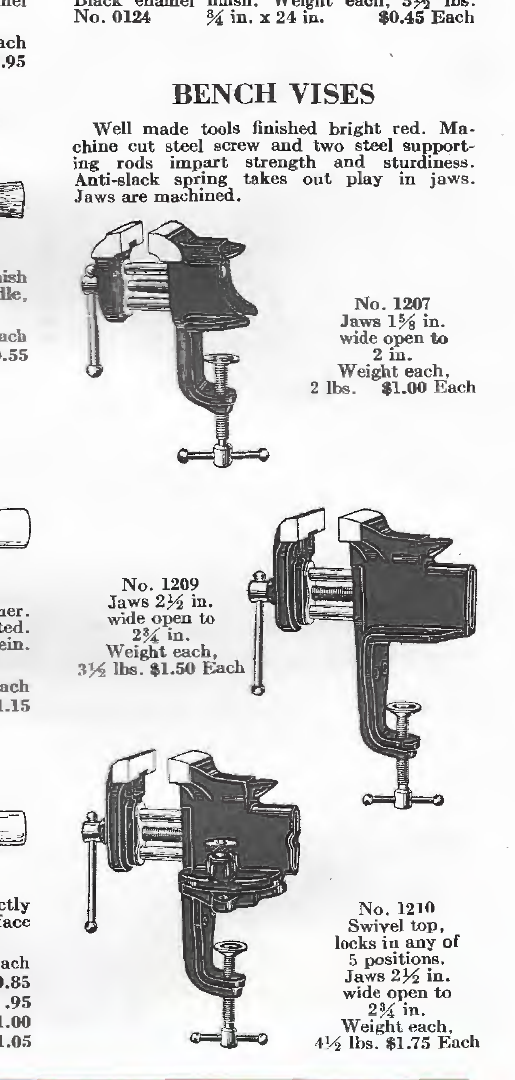
Stanley Tools Catalog No. 139 provides an unusually clear snapshot of the Defiance vise lineup in 1939. The catalog groups the No. 1207, No. 1209 and No. 1210 together under the simple heading “Bench Vises.”
Stanley described them as well-made tools finished bright red, using a machine-cut steel screw and two steel supporting rods. The catalog specifically mentions an anti-slack spring intended to remove play in the jaws and notes that the jaw faces were machined.
That original description is useful today because modern auction and marketplace listings often call these “jeweler’s vises,” “gunsmith vises,” “hobby vises” or almost anything else that sounds marketable. Stanley itself simply sold them as compact bench vises.
The Known Defiance Vises
Three of the four known vise models can be tied directly to the 1939 catalog. The fourth—the No. 1240 wedge vise—is a completely different style of holding tool and gets its own section farther down the page.
The Small Clamp-On Vise
The smallest vise in the 1939 Defiance lineup. It clamps directly onto a bench or table, making it portable and useful where a permanently mounted vise was unnecessary.
The Larger Fixed Vise
The 1209 uses the same general clamp-on concept but steps up to wider jaws and a heavier body. It is probably the model most often encountered today under modern seller descriptions such as “jeweler,” “gunsmith” or “hobby” vise.
The Five-Position Swivel Vise
The most elaborate of the three cataloged bench vises. Its upper vise body can swivel and lock into one of five indexed positions, giving the user considerably more flexibility without sacrificing the portable clamp-on base.
Working Vise & Clamp Registry
The four numbered models below form the current documented Defiance vise family. Several additional Defiance-branded clamps have been reported or identified during the larger project but remain research subjects until their model numbers and catalog appearances can be established.
| Model | Type | Jaws | Capacity | Notes | Evidence |
|---|---|---|---|---|---|
| 1207 | Clamp-On | 1⅝” | 2″ | Smallest of the 1939 bench-vise lineup. | 1939 Catalog |
| 1209 | Clamp-On | 2½” | 2¾” | Larger fixed-body version; 3½ lb. | 1939 Catalog |
| 1210 | Swivel Clamp-On | 2½” | 2¾” | Swivel top locks in five indexed positions. | 1939 Catalog |
| 1240 | Wedge Vise | — | Variable | Bench/floor-mounted wedging-action holding tool. | Documented |
| Unknown | Clamp | — | — | Defiance-branded clamp; model identification needed. | Research |
| Unknown | Handscrew Clamp | — | — | Reported in current research; catalog confirmation needed. | Research |
| Unknown | C-Clamp | — | — | Reported in current research; model number unresolved. | Research |
There Was Real Engineering Behind These Little Vises
The Defiance line was sold as an economical alternative, but “economical” did not mean Stanley simply threw together whatever parts were cheapest. Two Austin L. Stowell patents assigned to The Stanley Works help explain what was happening inside these compact vises.
U.S. Patent 1,999,600 — Anti-Slack Vise Mechanism
Filed in 1933 and granted April 30, 1935, this patent describes a small bench or table vise using an adjusting screw, guide rods and a spring arrangement designed to reduce lost motion between the screw and movable jaw.
That is particularly interesting because the 1939 Defiance catalog specifically advertises an “anti-slack spring” that removes play in the jaws.
View Patent 1,999,600 →U.S. Patent 1,959,936 — Indexed Swivel Vise
Filed April 19, 1932 and granted May 22, 1934, Stowell’s earlier vise patent adds an angularly adjustable body, pivoting base and spring-loaded indexing mechanism.
The design closely parallels the feature Stanley later advertised on the Defiance No. 1210: a swivel top capable of locking into five positions.
View Patent 1,959,936 →The Defiance Wedge Vise
The No. 1240 is unlike the screw-operated clamp-on vises above. It is a long, low-profile holding device designed to be secured to a workbench or floor and to grip stock using wedging action.
Surviving examples are known with their original boxes, which is particularly valuable because the packaging helps explain a tool whose purpose may not be obvious when it is encountered loose. Auction records describe stock being slid into the vise and locked through the action of the wedge rather than by tightening a conventional vise screw.
The 1240 also appears infrequently enough that the current Idle Hands Workshop rarity research treats it as one of the harder Defiance holding tools to locate—especially complete with its wedge and original packaging.
Identifying a Defiance Vise in the Wild
These are frequently listed online without the Defiance model number—or under modern descriptions that Stanley never used. A few details can make identification considerably easier.
Surviving examples may carry the Stanley, Defiance and model-number markings in places that are easy to miss. Do not assume an apparently unmarked vise is unidentified until the screw ends, casting and clamp base have been inspected carefully.
Patent numbers and MADE IN U.S.A. markings are known on surviving Stanley examples. Patent 1,999,600 is particularly useful when investigating the fixed-body clamp-on design.
The quickest distinction is the swivel mechanism. The 1209 is the larger fixed-body vise, while the 1210 adds the indexed rotating upper assembly and weighs about a pound more.
“Jeweler’s vise,” “gunsmith vise,” “machinist vise” and “hobby vise” are common modern descriptions. They may describe how somebody uses the tool, but they are not necessarily Stanley’s original product names.
Catalog No. 139 describes the 1939 vises as bright red. Original paint is useful evidence, but later production, Handyman relatives, repainting and decades of wear mean color should never stand alone as proof.
Jaw width is one of the simplest checks. The 1207 uses 1⅝-inch jaws, while both the 1209 and 1210 use 2½-inch jaws. Combined with the swivel feature, that makes the three cataloged models relatively easy to separate.
The Clamp Side of the Research Is Not Finished
The numbered vises are reasonably well established, but the broader Defiance clamp family still contains several loose ends. These remain on the research list rather than being presented as fully documented catalog models.
A Defiance-branded clamp is recorded in the working registry, but its model number and catalog history still need to be pinned down.
Another reported holding tool that needs stronger primary documentation before its exact place in the product line can be considered settled.
C-clamps fit naturally within the scope of the Defiance workshop line, but the currently recorded example remains a model-number research target.
Research Sources
Primary Stanley material remains the preferred source wherever it survives, supplemented by patent records, collector research and documented surviving examples.
Major sources for this section include Stanley Tools Catalog No. 139 from 1939, the Austin L. Stowell vise patents assigned to The Stanley Works, surviving examples and documented auction records of the No. 1240 wedge vise.
Continue Through the Defiance Archive
From things that hold the work to the tools that cut, drill and beat on it—there are plenty more rabbit holes available.