Last updated on August 11, 2026
Every fictional world has a beginning. Sometimes it starts with a carefully outlined novel, sometimes with a character sketch, and sometimes with nothing more than a single image that refuses to leave your mind.
For Mechanica, it began with one steampunk image created in 2010.

There was no finished city of Brasshollow, no completed history of Mechanica, no three-book storyline, and no collection of characters waiting neatly in the wings. There was simply an image with the right atmosphere: brass, machinery, Victorian elegance, clockwork, and that wonderful mixture of technology and imagination that makes steampunk feel as though someone discovered a branch of history that never actually happened.
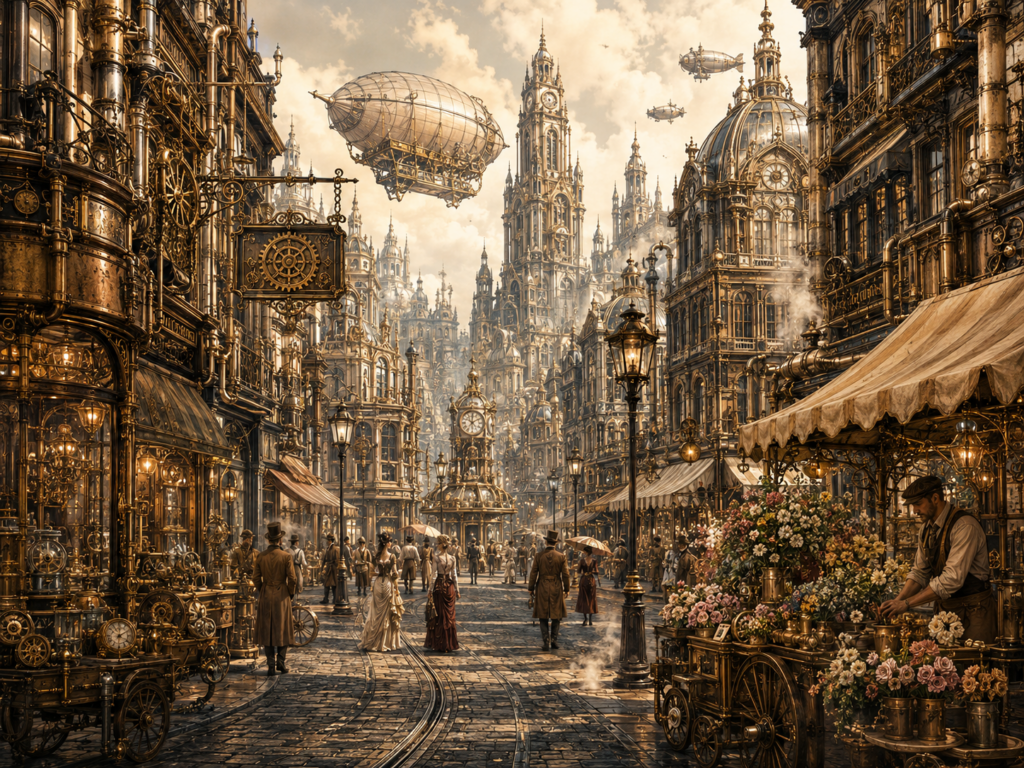
I already had ideas for a story, but that image gave those ideas somewhere to live.
The first question was not really, “What should this picture become?” It was, “Who lives in this world?”
That question led to Elias Greystone.
Elias became the inventor at the center of the story: brilliant, patient, sometimes stubborn, and carrying more history than he lets on. He was never intended to be the stereotypical mad scientist surrounded by sparks and impossible machinery. He needed to feel human. He had loved, lost, raised a daughter, spent a lifetime making things, and eventually reached a point where an idea he had carried for years could finally become something real.
That idea became Project E-7.
Mechanica.
From the beginning, the important part of Mechanica was never simply that she was a mechanical woman. Steampunk is full of automatons, clockwork people, artificial servants, and elaborate machines. I wanted the story to ask something different.
What happens when the machine begins to wonder who she is?
What happens when something built from brass, gears, valves, springs, and aether begins to experience curiosity, affection, fear, memory, grief, humor, and love?
And perhaps more importantly: at what point do the people around her stop thinking of her as something that was built and begin thinking of her as someone?
Once that idea took hold, the world began growing very quickly.
Elias needed someone who connected him to ordinary human life, and that became his daughter, Katelyna Greystone. She could understand her father’s genius without always agreeing with him. More importantly, she could respond to Mechanica in ways Elias could not. Elias naturally sees mechanisms, tolerances, pressure, balance, and design. Katelyna sees a person learning how to exist.
That difference became an important part of the story.
Then came DaVinci.
Or, as everyone eventually knows him, Tink. He got this nickname because of the sounds his metal paws made on the ground as he walked and ran around.
Tink became one of those characters who quickly grew beyond the job originally assigned to him. A mechanical companion could easily have been little more than background decoration in a steampunk story. Instead, Tink became part dog, part machine, part comic relief, part emotional anchor, and eventually something much more important to Mechanica herself.
The more these characters developed, the less the project felt like a collection of illustrations and the more it began to feel like a real place.
That was when the work changed.
Instead of creating one attractive image at a time, I began treating Mechanica almost like a film production. The characters needed to remain recognizable from scene to scene. Workshops needed to feel as though the same people actually worked in them. Clothing, machinery, architecture, clocks, pipes, gauges, tools, and decorative elements had to belong to the same visual language.
Reference images became character sheets. Character sheets became recurring designs. Individual scenes became sequences. Sequences became acts. Eventually there was enough material that the project was no longer simply about making illustrations.

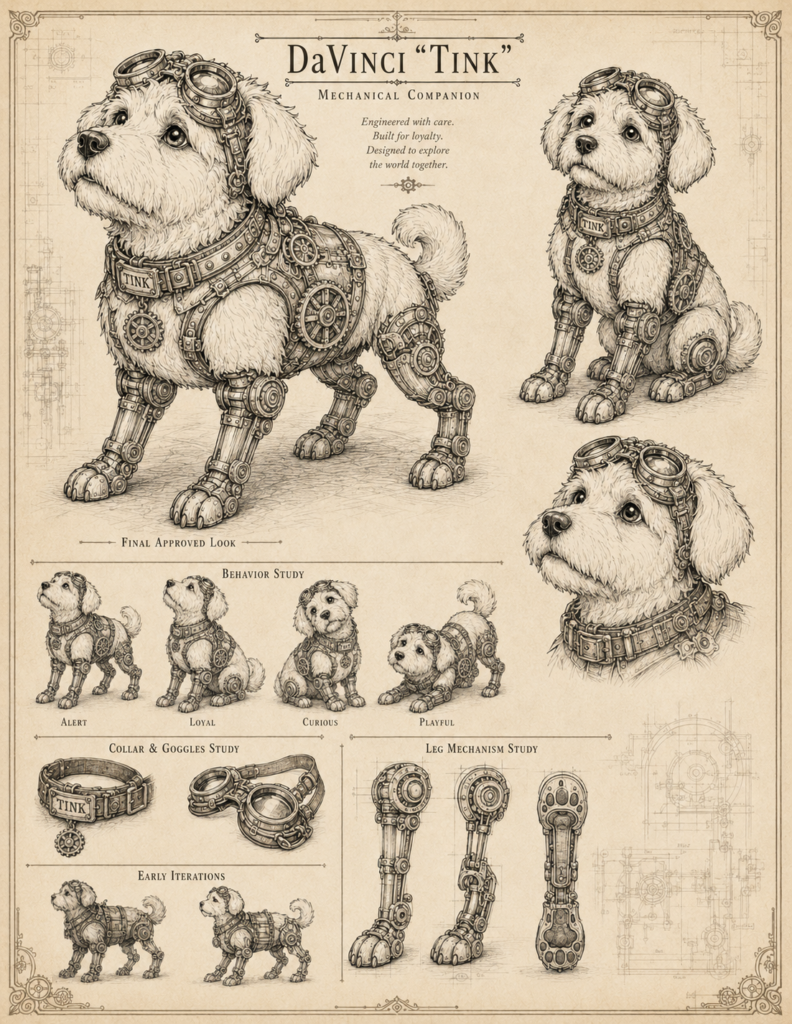
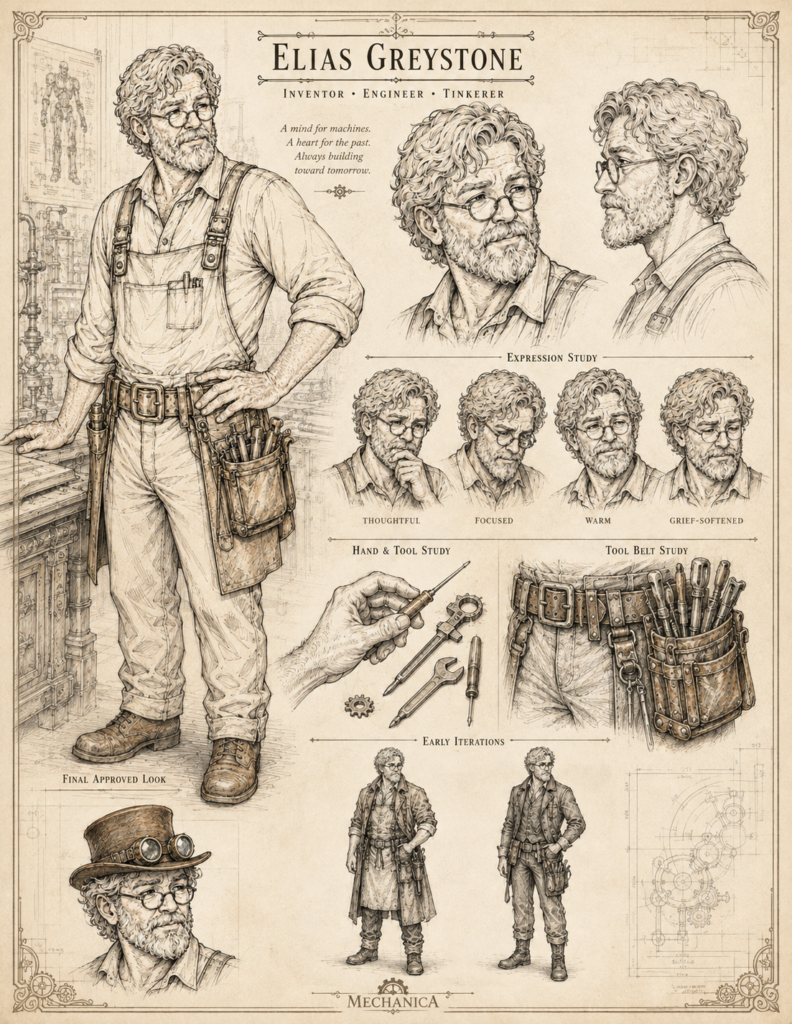


We were building a world.
The storyline was developed first and the artwork had to serve it, not the other way around. That distinction became increasingly important as the project grew. Beautiful artwork can catch someone’s eye, but without characters worth caring about it remains only a beautiful picture.
Mechanica needed a reason to exist beyond the machinery.
That reason became the relationship between creation and humanity.
The first book, Mechanica: Genesis, is exactly what its title suggests. It is the beginning.
Before Mechanica opens her eyes, Elias and Katelyna must finish what has occupied years of imagination, work, and emotion. The machinery matters, but the real story lies underneath it. Elias is not simply assembling components. He is reaching a point in his life where grief, solitude, invention, memory, and hope have all converged in the same workshop.
Mechanica is not created to replace someone who was lost. That would have made her little more than a substitute.
She is created because Elias still has something left to share.
Ideas. Curiosity. Quiet moments. Wonder.
And when her eyes finally open, the story changes.
That became Book Two: Awakening.
If Genesis is about creating Mechanica, Awakening is about Mechanica beginning to create herself.
Suddenly the questions become personal.
She knows what she is made from, but that does not tell her who she is.
She can understand how a pressure gauge works, but understanding why someone is sad is much more difficult. She can learn the limits of her joints and mechanisms, but emotions have no convenient calibration marks. She can examine her construction, but the more she learns about herself, the more questions appear.
Why does she remember certain things?
Why does kindness matter?
Why does she care about Tink?
Why does grief hurt when she was never supposed to feel pain in that way?
And what exactly is the aether within her?
Those questions allowed the world outside Elias’s workshop to become important as well. Mechanica could not truly awaken while standing in the same room where she was built. She had to encounter people, streets, machines, danger, beauty, ordinary kindness, confusion, and the unpredictable behavior of human beings.
The world had to become larger because Mechanica’s understanding of it was becoming larger.
That progression naturally led toward Book Three: Companion.
By then, the story is no longer merely about whether a machine can become human enough to understand people.
It becomes a story about belonging.
Mechanica has Elias. She has Katelyna. She has Tink. She has memories, questions, fears, and experiences of her own. The relationships between these characters begin to matter as much as the mystery surrounding Mechanica’s creation.
And Tink, who began as the little mechanical companion at the edge of the story, moves closer to its heart.
That evolution is one of my favorite things about building this series. Characters occasionally tell you that the role you originally gave them is too small.
The visual side of Mechanica evolved alongside the writing.
The artwork was developed with AI-assisted image tools, but the process was never a matter of typing a sentence, accepting whatever appeared, and calling it finished. Images were generated, rejected, corrected, edited, reworked, rearranged, and sometimes rebuilt repeatedly to maintain continuity with the storyline and established character designs.
A character appearing correctly once is easy.
Making that same character recognizable fifty pages later, from another angle, wearing different clothing, showing a different emotion, standing beside the same characters, inside the same world, while still advancing a specific scene is an entirely different problem.
That is where art direction and world building became the real work.
The story determined what needed to happen. Character references determined who needed to appear. Earlier scenes determined how they should look. The developing visual language of Mechanica determined what belonged in the environment and what did not.
Over time, the project accumulated its own library of visual assets and reference material. Elias became Elias. Katelyna became Katelyna. Tink became unmistakably Tink. And Mechanica gradually developed from an idea into a character with a visual identity strong enough that changing the wrong detail could immediately make her feel like someone else.
Something else happened along the way that I had not fully planned at the beginning.
The books became interactive.
The artwork naturally lent itself to detailed line work, and that opened the door to turning the series into a color-your-own graphic novel.
Instead of deciding exactly what every piece of brass, every dress, every workshop wall, and every sky must look like, part of that decision could belong to the reader.
That changed the relationship between the book and the person holding it.
A reader is not simply watching the world of Mechanica unfold. They can help finish it.
One person may imagine Elias’s workshop in warm browns, brass, and copper. Someone else may give the machinery cool steel tones. Mechanica’s clothing, the glow of aether, the streets, the flowers, the skies, and hundreds of tiny mechanical details can become slightly different in every copy.
The printed story remains the same.
The finished world does not.
That feels particularly appropriate for a story about creation.
What began as one steampunk image has now become a growing world with its own people, history, mysteries, visual language, and future.
There are workshops filled with half-finished inventions. There are streets beyond those workshops. There are memories whose meaning has not yet been completely revealed. There are relationships still developing. There are questions about aether, consciousness, invention, grief, identity, and what it actually means to possess a soul.
And there are still places in this world that I have not shown anyone yet.
That may be the strangest and most satisfying part of the entire process.
At some point, Mechanica stopped feeling like something assembled one page at a time and started feeling like a place I could visit.
All because one image suggested that somewhere, in a workshop filled with brass and gears, someone was building something extraordinary.
I simply wanted to find out who they were building.
And why.
Learn more about The World of Mechanica here on the site: https://idlehandsworkshop.xyz/the-world-of-mechanica/

